
The new Sheep Ireland Genetic Evaluations were launched this week, with updated Economic Values & new Traits being included.
There are three main updates being introduced for 2026.
- Updated Economic Values
- Introduction of a new Faecal Egg Count (FEC) trait
- Updated methane trait and inclusion of carbon values on some traits
These updates result in some minor shifts of the relative emphasis of traits within the Replacement and Terminal Indexes.
Why update Economic Values and how does the model work?
Production costs and lamb prices have changed significantly in recent years and the underlying bio‑economic model which generates the economic values required updates to stay accurate and reflective of modern-day sheep farming. The Bio-economic Lamb Production Model is a simulation of a commercial Irish sheep farm which determines the effect of system changes on profitability. It is a whole‑farm model and simulates a 12‑month production cycle beginning at mating, validated against Teagasc e-profit monitor flocks.
How will a Methane trait drive farm profitability?
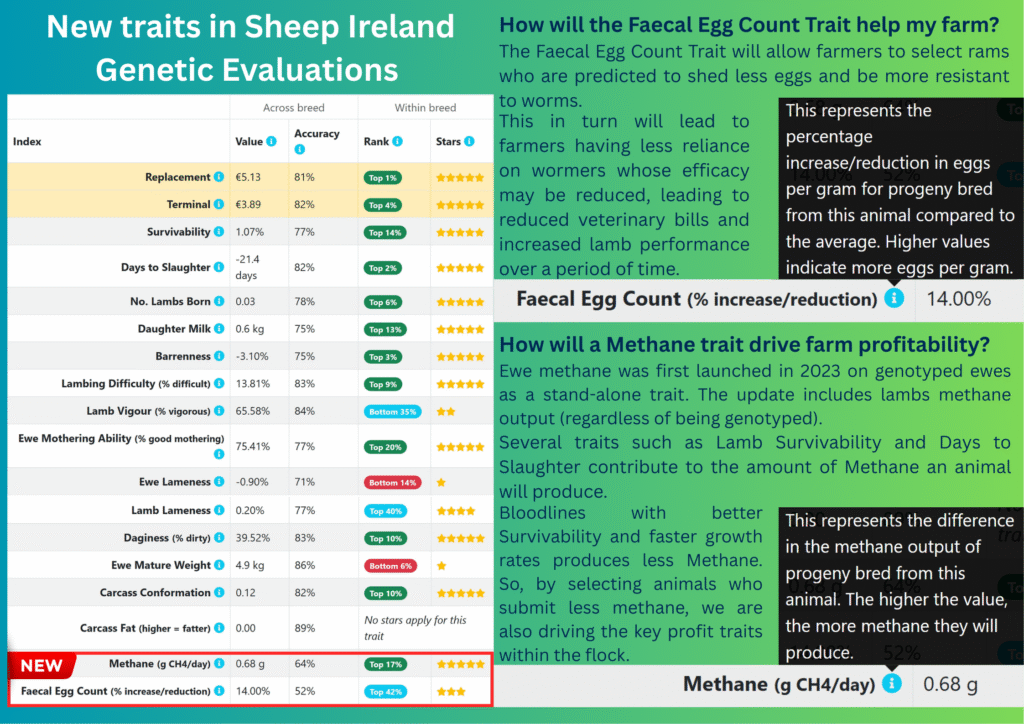
Ewe methane was first launched in 2023 on genotyped ewes as a stand-alone trait. The update includes lambs methane output (regardless of being genotyped). Several traits such as Lamb Survivability and Days to Slaughter contribute to the amount of Methane an animal will produce. Bloodlines with better Survivability and faster growth rates produces less Methane. So, by selecting animals who submit less methane, we are also driving the key profit traits within the flock. It’s a win – win.
How will the Faecal Egg Count Trait help my farm?
Anthelminthic resistance is a growing concern for the Irish Sheep Industry. The Faecal Egg Count Trait will allow farmers to select rams who are predicted to shed less eggs and be more resistant to worms. This in turn will lead to farmers having less reliance on wormers whose efficacy may be reduced, leading to reduced veterinary bills and increased lamb performance over a period of time.
Will there be re-ranking of animals Star Ratings?
The vast majority of the current population are expected to maintain their current rankings with some individual animals having minor movements. This is largely because input cost and output cost have all increased at a similar rate. While there will be some individual animals that do move, as is normal when new evaluations are released, the overall population remains very stable and results in an acceleration of the genetic gain of the National flock due to better data, more precise modelling and additional traits.
Where can farmers find the new traits?
The new traits are available to see for all rams on the Sheep Ireland Ram Search (www.ramsearch.ie). Once a farmer selects an animal of interest, they will see details of the Replacement and Terminal Indexes, along with four sub-indexes. There is a button that says ‘See more traits’. If farmers press this button, they will be able to see information for the Faecal Egg Count trait and the methane trait, as well as a host of other traits that are also available.
What benefits can farmers expect from the latest updates?
With the Replacement Index, farmers can expect to see more productive, fertile ewes, with better mothering ability and higher milk yield which will lead to increased growth of lambs in early and peak lactation, all while maintaining the ewe mature weight.
From a Terminal Index standpoint, the updates will lead to more lambs surviving past 48 hours, less farmer intervention at lambing time and faster finishing lambs all while reducing worm burden and their carbon footprint. These updates enhance the standing of Irish sheep farmers, ensuring they hold a progressive alignment with other lamb‑producing countries.
What will the updates deliver for the Irish Sheep Industry?
Overall it is estimated that the updates will deliver ~€20 million from the Replacement Index and ~€15million from the Terminal Index. This can be achieved as farmers will be able to breed healthier more resilient sheep, reduce costs linked to worms and the performance issues that come with worms, improve lamb growth, increase lamb survival, which all lead to increased long-term profitability.
Click here for more information:
The National Sheep Breed Improvement Programme is ready to level up in Breeding Efficiency – Sheep Ireland
If there are any further queries, please feel free to contact Sheep Ireland by email – [email protected].