

Farmers across the country are set to benefit from advancements in breeding efficiency and flock performance following the latest updates shared at the Sheep Ireland Industry Meeting, held on Thursday, December 11th in Tullamore, Co. Offaly.
The event brought together industry stakeholders, including LambPlus members, researchers, breed societies, DAFM, and other industry representatives, to discuss the latest research and updates to genetic evaluations that will be implemented in Ireland’s national sheep breeding improvement programme in early 2026.
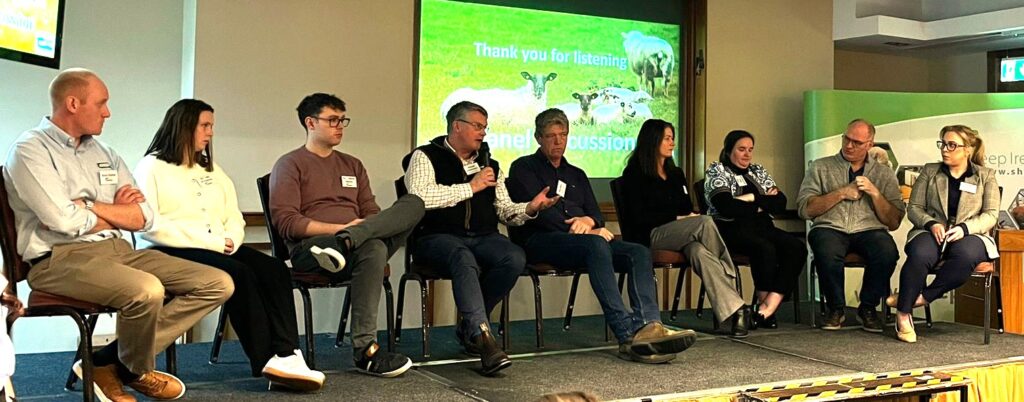
At the meeting, attendees had the opportunity to hear from leading Teagasc and Sheep Ireland researchers, who provided in-depth presentations and addressed farmer and industry stakeholders questions throughout the morning. Their insights offered clarity on how the latest scientific findings will translate into meaningful improvements on the ground. Speakers were joined by two long standing LambPlus farmers on a panel discussion, taking many questions from the floor.
Key messages for 2026 €uroStars Evaluations
The vast majority of animals are expected to maintain their current rankings with some individual animals having minor movements. Like all previous years evaluations, there will be a cohort of animals that will be ranked higher or lower with the new evaluation updates but most importantly the overall result will be an acceleration of genetic progress.
With enhanced data and a more up-to-date economic modelling, the programme is designed to:
- Improve breeding efficiency (faster progress in lamb survival, lambing ease, lamb vigour, and maintaining growth).
- Enable more genetic gain within flocks.
- Ensure breeding targets align with both market demands and sustainability goals by slowing methane emissions.
The Industry Meeting underscored a clear message:
Through innovation in genetics, sustainability, and economic modelling, the national breeding programme is set to deliver powerful tools that will help farmers to achieve consistently better results, breeding more efficient animals and systems.
Where will these Indexes take us in 10 years?
Benefits of using a 5-Star Terminal Ram:
- More lambs (more survival)
- Less handling of ewes at lambing
- More lambs that get up and go at lambing
- Faster finished lambs
- Producing less methane
- Additional profit to the Industry estimated at €15 million
Benefits of using a 5-Star Replacement Ram:
- More lambs (more survival and NLB)
- More productive ewes – less barren & better mothers
- More milk (faster early growth)
- Faster finished lambs
- Maintaining ewe mature size
- Producing less methane
- Additional profit to the Industry estimated at €20 million
The research presented on the day is part of an ongoing effort to improve the accuracy of the genetic evaluations to benefit Ireland’s national flock. The results of studies, the impact they have on the national sheep breed improvement programme were presented on the day.
Find a direct link to each presentation given on the day below:
Dr. Orla Keane – OVIFEC: Developing genetic parameters for worm resistance in sheep
Eoin Dunne – Collection of enteric methane data
Dr. Edel O’Connor – Updating the economic values
Dr. Jonathan Herron – Carbon values
Dr. Noirin McHugh – Impact of updates to the industry
Dr. Thierry Pabiou – Impact of updates on star ratings
Also take a look at the insightful poster session that was on display on the day, click link here.

Overview of the three main topics of discussion on the day:
- Updated Economic Values reflecting net profit and variable costs
Teagasc’s latest updates to the Bio-economic Model introduce up-to-date costings driving an overall increase in most economic values. These updates mean that breeding decisions made using €uroStars are aligned with the current economy helping to maximise profitability through more informed selection decisions.
- Breeding for Worm Resistance through FEC (Faecal Egg Count)
Breakthroughs in FEC research are enabling breeders to identify animals with genetic resistance to worms. By incorporating this data into €uroStars evaluations, farmers will be able to breed sheep that require fewer treatments, lowering labour and veterinary costs while improving flock genetic resistance. This marks a major step forward in long-term, sustainable flock health management.
- Breeding more efficiently by reducing carbon footprint while not affecting performance traits
Famers will be able to genetically select sheep that produce lower methane emissions without unfavourable impacts on performance traits. This positions Ireland’s national breeding program very well internationally with other major sheep meat producing countries. Most importantly from the research presented reducing our carbon footprint through breeding indexes supports national climate goals without compromising productivity. These updates position Irish sheep farmers competitively while contributing to a more sustainable future.
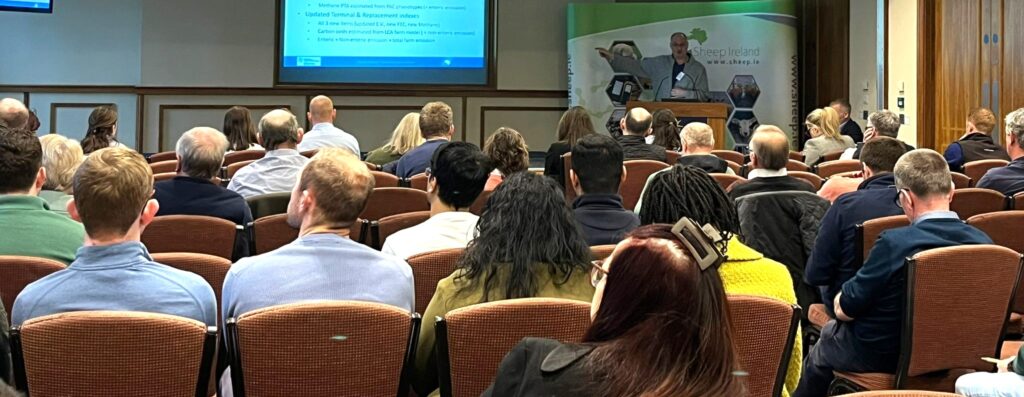
Sheep Ireland would like to sincerely thank all panellists who presented and contributed and Dr. Donagh Berry who kindly chaired the meeting. We would also like to thank everyone who attended the meeting and contributed to the informative discussions.