
Where can I check the Genomic results online?
Once your rams are tagged and sampled, send the samples to the lab using the pre-addressed envelope. Registered post is recommended. Results are typically available within 4 weeks, so be sure to submit samples in good time.
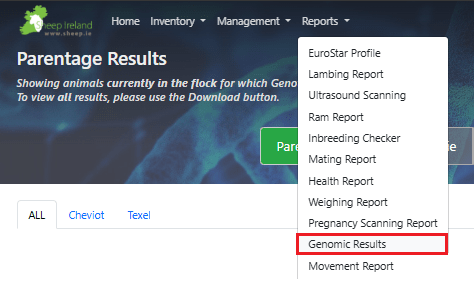
When results are published you will receive an email. To view them on your Farmer Homepage, log in to your Sheep Ireland account, click on the Reports tab, and select Genomic Results.
You can also do a quick check online by entering the ram ID on Ram Search .
Genomic Results are split into three sections:
Parentage Results
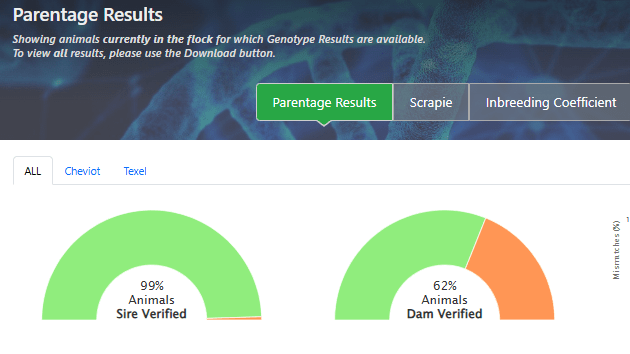
This is the default screen you’ll see when accessing the genomic results. Within this screen, you can analyse if the animals you have genotyped in your flocks were done so successfully and if and where any issues arose with your DNA samples, those issues will appear here. Where animals have successfully been genotyped and verified to parents these will appear here also.
A table will appear with the list of animals that are successfully genotyped. The ID of animals sire or dam will automatically appear if they are genotyped and match via DNA. If the sire appears as “not recorded on database” that means the sire is not genotyped (therefore will not be eligible for SIS)
Scrapie
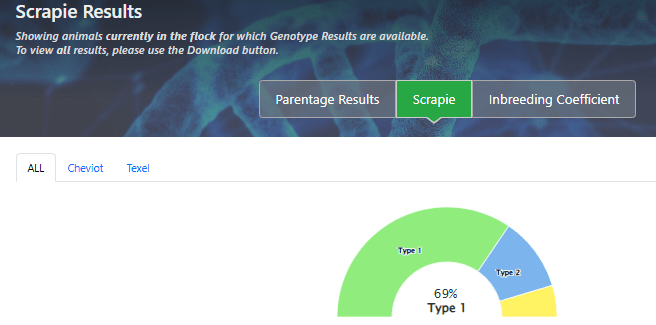
Scrapie is a fatal, degenerative disease affecting the central nervous system of sheep. It’s classified as a transmissible spongiform encephalopathy (TSE). Sheep that are scrapie type 1 are genetically most resistant to scrapie. Sheep that are type 5 are highly susceptible to scrapie as is recommended that they are not kept for breeding
To view scrapie results select the “Scrapie” tab at the top of the genomic results screen. The scrapie type will be displayed for each animal in the 7th column of the table. Any animal that is sire verified and scrapie type 1/2/3 is eligible for the Sheep Improvement Scheme. Animals that are scrapie type 4/5 are not eligible.
Inbreeding Coefficient
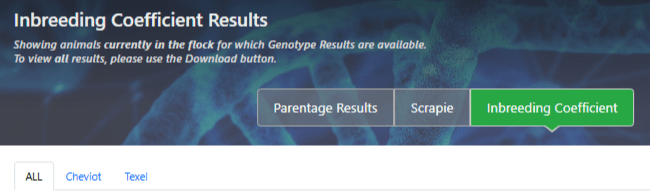
The inbreeding coefficient is a measure used to determine the level of genetic relatedness or the degree of inbreeding within a genotyped animal. A lower inbreeding coefficient signifies lower degree of inbreeding.
Higher inbreeding coefficients signify higher degrees of inbreeding. It is recommended that breeders try not to exceed an inbreeding coefficient of 6.25% for any animal (especially for breeding animals).
To view the inbreeding coefficient of genotyped animals select “inbreeding coefficient” tab at the top of the genomic results screen.
When is the Genomic result included in the Genomic Evaluation?
The genotype is then included in the next genomic evaluation run, being published the following week after receiving the results.
Read more here: The timeline for getting Genomic results and Genomic Evaluation – Sheep Ireland