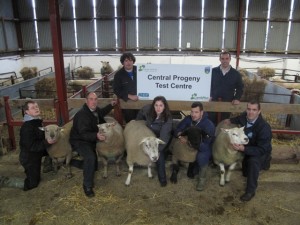
Central Progeny Testing (CPT)
The CPT was established in 2009 and its main function was to fast track and maintain genetic linkage among performance recording flocks in Ireland. It carries out this function by bringing together influential bloodlines across the most widely used sheep breeds in Ireland and using them together across commercial ewes contracted by Sheep Ireland to carry out intensive performance recording.
The Central Progeny Test (CPT) was set up not as a breed comparison, but rather as a ram and trait comparison. It is focused on identifying our best sheep genetics regardless of breed.
The CPT provides the basis for assessing a large number of rams, and linking this information to an even wider number of animals throughout that breed’s pedigree history.
Watch this video about how the CPT works:
Sheep Ireland uses the CPT flocks to assess the performance of sheep in a commercial setting and to validate the EuroStar ratings. This simply means testing if the 5-Star rams are actually outperforming their 1-Star counterparts in a commercial setting.
Ewes are impregnated by AI using semen collected from these pedigree rams, and a number of carefully selected rams are also purchased by Sheep Ireland annually and used via natural mating within these CPT flocks. This work all contributes to delivering the most accurate €uroStar evaluations as possible to Irish sheep farmers.
All rams are sourced from active LambPlus Flocks based on the number of relatives the ram has in other LambPlus flocks and their Replacement index along with other criteria.
Performance data is collected on all the resulting lambs & this information is included in each ram’s individual evaluation along with its relatives evaluations.
Genetic links between breeds and breeding groups are critical elements of any genetic evaluation programme. Without genetic linkage, the performance of different groups of sheep could not be fairly evaluated. The intention of the CPT is to evaluate as many new sires as possible annually, while genetically linking new bloodlines and strengthening existing ones as best possible throughout Ireland.
What is Genetic Linkage?
To maximize the genetic linkage that can be delivered by the CPT, Sheep Ireland attempt to locate widely used pedigree sires across different regions around the country. By taking these rams to a single location and using them on the same flocks, this is genetic linkage working at its very best. Environmental influences on lamb performance are largely eliminated as all lambs are subject to the same conditions, be they climatic, feeding, level of management etc. Essentially rams are now truly operating on a level playing field.
The CPT is a fundamental pillar of the sheep breed improvement programme:
- Source of independent commercial data
- Establishing Genetic Linkage
- Validation of the indexes
- Investigating new traits
- Building across-breed dataset
Evolution of the Sheep Ireland Central Progeny Test
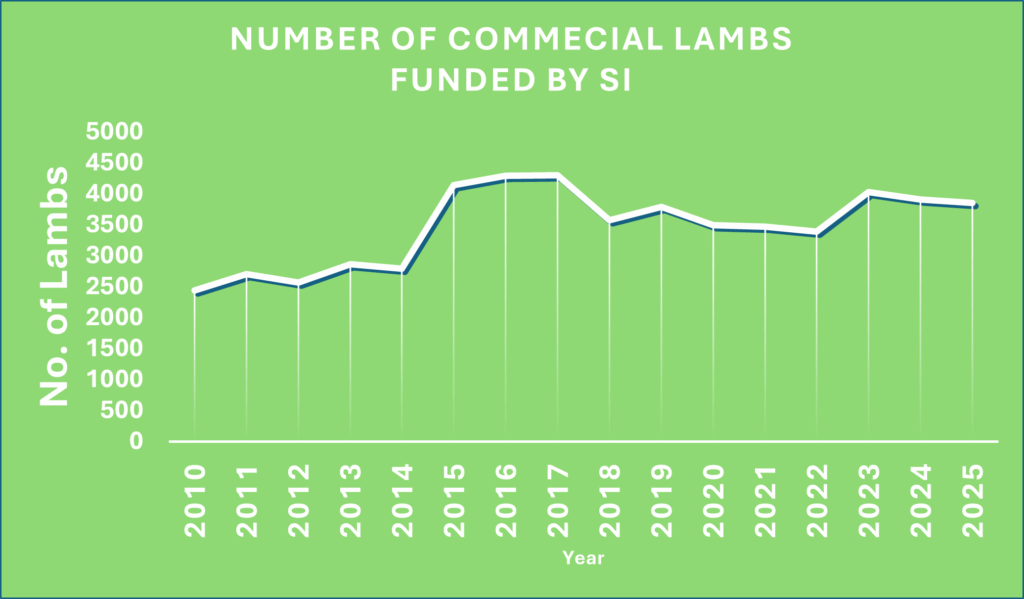
Early Foundations and Genetic Linkage
In its early years, the CPT relied on Single Sire Mating (SSM) to assign parentage, using influential bloodlines from widely used sheep breeds. This approach ensured strong genetic linkage across flocks. However, with the advent of genomic technologies, parentage is now assigned through genotyping, with DNA samples collected from all CPT animals.
CPT flocks are commercial operations contracted by Sheep Ireland to carry out intensive performance recording. While laparoscopic artificial insemination (AI) was initially the standard, the program now primarily uses cervical AI and natural mating methods. The adoption of genomic technologies has opened the door to even more data as parentage can now be assigned to lambs where Single Sire Mating has not taken place.
Validating Genetic Indexes
A core function of the CPT is to validate genetic indexes on commercial farms. The program has consistently demonstrated that selecting 5-star rams with superior genetics leads to improved productivity and profitability for sheep farmers.
To date, Sheep Ireland has used over 400 different rams in the CPT, representing a diverse array of bloodlines. The data collected feeds directly into the EuroStar Indexes, which are publicly available in sales catalogues and online via Ram Search.
Data Integration and Genetic Evaluations
Crucial slaughter data from these flocks is integrated into genetic evaluations via an API from meat processors, providing essential insights into traits like Days to Slaughter. These records form a fundamental part of the Terminal and Replacement Indexes.
Beyond Sheep Ireland-funded flocks, data also flows in from various sources:
- Teagasc research flocks
- Teagasc BETTER Farms
- Agricultural colleges using performance recording as an educational tool
- Independent commercial flocks, including Tullamore Farm
- Pedigree breeders recording commercial animals
Get Involved
Sheep Ireland encourages all commercial farmer interested in performance recording their flock to join LambPlus.
The long-term benefits of participating in this program can be substantial, offering improved flock performance and profitability.
To know more about the traits being recorded, click here.
Some history:
The CPT was first started in 2009 with 30 Rams from 5 Breeds used through AI across 2100 ewes.
In the past semen from these influential CPT rams had been promoted to interested breeders (targeting unlinked flocks) by Sheep Ireland and the relevant sheep breed societies. Also, many sheep breed societies had established sire reference schemes (genetic linkage schemes), whereby semen from promising rams was available to breeders to establish linkage. These initiatives had hugely positive effects on genetic linkage within the respective sheep breeds.
The CPT was set up to:
- Examine how much industry rams can vary in growth rate to slaughter.
- Examine how much industry rams vary in maternal merit.
- Foster links between Breed Societies, Ram Breeding Groups, and the wider Breeding Industry.
- Identify leading sires and benchmark sires.
- Demonstrate to the industry the extent to which rams varied in the value they could add to farm returns.
- With the collection of valuable data, improve our understanding of the genetic control of carcass merit and maternal merit and their relationship with other production traits.